A Weekend in Comporta: Your Perfect Plan! (created…
Planning a weekend in Comporta? Discover my two-day itinerary for…
When you first start surfing, there’s a lot happening at once.
You have to paddle, read the wave, control the board, stand up, find your balance and somehow work out what the ocean is doing around you.
Making mistakes is completely normal.
After many years in the water and helping people catch their first waves, there are a few mistakes I see again and again.
The good news is that many of them are relatively easy to correct.
If you’re just starting out, these are the mistakes I’d pay the most attention to.
In your first few sessions, I wouldn’t get too caught up in catching lots of waves or staying on your feet for a long time.
First, focus on building confidence, learning the right movements and beginning to understand the ocean.
The rest comes with practice.
Mistake | What to do instead |
Choosing conditions that are too difficult | Look for waves that suit your level |
Using a surfboard that’s too small | Prioritise stability and volume |
Stopping paddling too early | Keep paddling until you feel the wave carrying you |
Looking down at your feet | Look where you want to go |
Trying to progress too quickly | Build a solid foundation first |
Focusing only on technique | Learn to read the ocean too |
Expecting to improve from one session to the next | Give yourself time to practise and repeat the basics |
This is probably one of the most important mistakes.
When someone starts enjoying surfing, it’s natural to want bigger waves or to seek out the beach they saw in a video.
I’d do exactly the opposite.
A good wave for learning isn’t necessarily an impressive-looking wave.
I look for conditions that allow a student to repeat movements, feel comfortable and spend enough time on the board to really learn.
A wave that’s too powerful can turn the whole session into a battle just to get through the breaking waves.
And then you’re using up energy, but probably not learning very much.
Choose waves for the surfer you are today, not the one you’d like to be in six months.
If it’s your first experience, that’s also why I recommend learning with someone who knows the beach and can assess the conditions on the day.
At Imagine Surf School, our beginner surf lessons follow exactly that approach: we adapt each session to the student’s level and the ocean conditions.
I understand the temptation.
Smaller boards look fast and light, and they’re the ones we see many experienced surfers riding.
But that doesn’t mean they’re the best tool for learning.
When you’re starting out, a bigger, more stable board helps you paddle, catch waves and practise your take-off much more easily.
With a board that’s too demanding, you can spend much of the session struggling with things that would already be challenging enough with the right equipment.
I’d choose the board that helps me learn first. Style can come later.
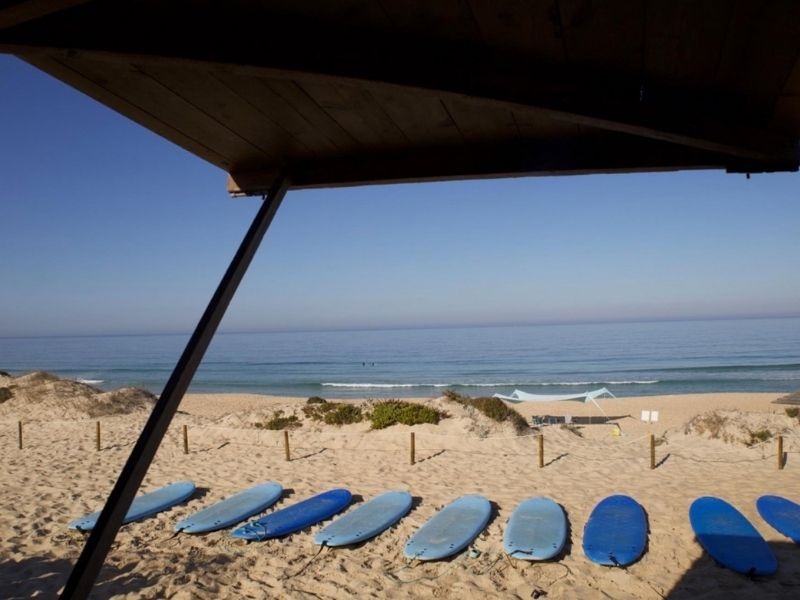
I see this all the time.
The wave approaches.
The student starts paddling.
They feel the board pick up a little speed…
…and stop paddling.
Usually too soon.
To catch a wave, you need to build speed and keep paddling until you can clearly feel the wave starting to push your board forward.
When you think you’ve paddled enough, try taking another two or three strong paddle strokes before starting your take-off.
It’s not an exact formula, but it’s a useful way to correct that early habit of stopping your paddling too soon.
Another classic.
When you’re learning to stand up, it’s natural to want to check where you’ve placed your feet.
The problem is that when you look straight down, the rest of your body tends to follow.
And your balance suffers.
From the very beginning, I teach one simple idea:
Look where you want to go, not down at your feet.
Your head and where you’re looking have a much bigger influence on your surfing than you might think.
And this isn’t just for beginners. The more you progress, the more you’ll realise how your gaze helps guide the rest of your body.
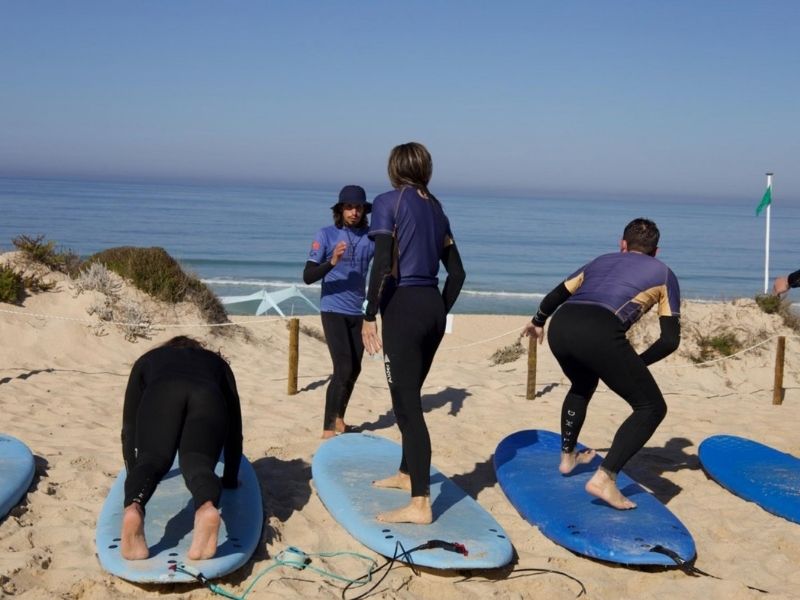
After catching your first whitewater waves, it’s natural to want to take the next step and start catching unbroken waves.
And that’s great. After all, it’s what we all want when we start surfing.
But a few fundamental skills make a huge difference once you begin paddling further out:
✓ Controlling your board;
✓ Paddling with confidence;
✓ Doing your take-off consistently;
✓ Finding a stable basic stance;
✓ Starting to control the direction of your board;
✓ Feeling comfortable in the water.
That doesn’t mean you have to master everything perfectly before trying to catch a green wave.
At Imagine Surf School, I like to adapt that progression to each student and the ocean conditions. If it’s safe and I feel you’re ready, we can start trying unbroken waves even during your first few lessons.
But more important than catching a bigger wave is beginning to understand what you’re doing on the board and feeling increasingly confident in the ocean.
For me, this is one of the biggest misconceptions.
Being able to stand up on a surfboard is great.
But it doesn’t mean you already know how to surf.
Over time, you’ll also need to learn:
That’s why I like to say that surfing is much more than just technique.
I want students to reach a point where they can make their own decisions in the water without needing someone beside them all the time.
Once those foundations are in place, the next step is to work on positioning, reading the ocean, turning and gaining greater control of the board – exactly what we develop in our intermediate surf lessons.
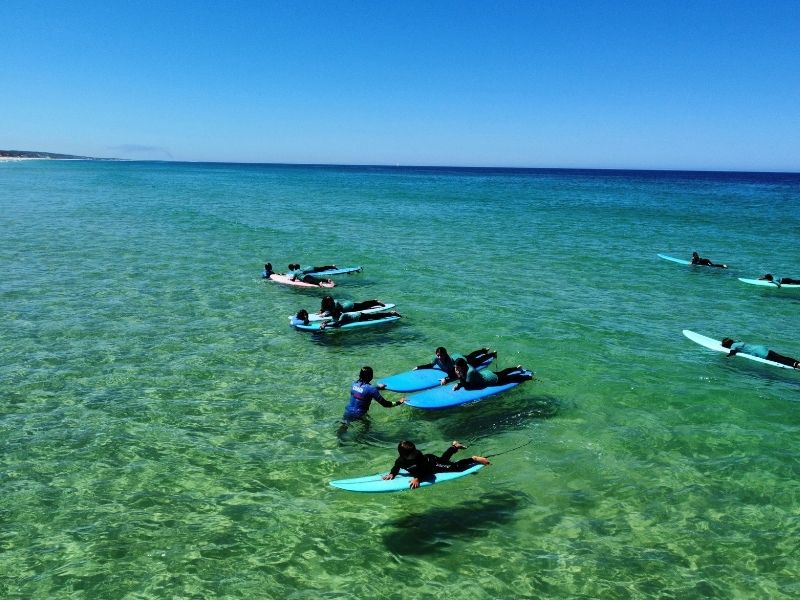
Some people stand up in their first lesson.
Others need more time.
And that’s absolutely fine.
The mistake begins when you compare your third session with someone who’s been surfing for three years.
There are too many variables in surfing for progression to follow a perfectly straight line: the waves change, the wind changes, the board changes and even you have better and worse days.
One lesson can be enough to try surfing, learn the basics and catch your first waves.
But really learning to surf takes repetition. Building confidence, consistency and independence in the ocean takes time.
I’d pay less attention to how many times you fell and more attention to small improvements:
✓ I’m catching more waves on my own;
✓ I need less help positioning myself;
✓ My take-off is becoming more consistent;
✓ I’m beginning to understand which waves to choose;
✓ I feel more comfortable in the water.
That’s progression too.
If I had to choose just one, it wouldn’t be a technical mistake.
It would be rushing too much.
Surfing is funny like that.
The more you try to force certain things, the harder they seem.
When you start to understand the timing of the wave, relax your body and accept that lots of attempts won’t work out, things usually begin to make much more sense.
That’s why, when I teach someone for the first time, I don’t just want them to stand up.
I want them to leave the water wanting to come back.
Before paddling out, I’d ask myself:
✓ Are the conditions suited to my level?
✓ Am I using the right board for what I want to practise?
✓ Do I know where to enter and exit the water?
✓ What’s the one thing I want to improve today?
✓ Am I willing to keep trying without getting frustrated when it doesn’t work?
That last one really matters. 🙂
There’s no single number that works for everyone. You might stand up and catch waves in your very first lesson, but becoming independent and consistent takes practice. I prefer to look at each person’s progress rather than set an exact number of sessions.
Absolutely. Falling is part of the process. The important thing is to gradually understand why it happened and try to correct one thing at a time, rather than changing five movements at once.
I wouldn’t rush into surfing alone after your first lesson. Before doing that, make sure you can control your board, enter and exit the water safely, recognise conditions that suit your level and understand the basic rules of wave priority. If you’re unsure, go with someone experienced.
If you just want to give surfing a try, one lesson can be a great first experience. If you really want to learn, several sessions give you far more opportunities to repeat movements, receive feedback and begin building independence.
I don’t know anyone who learnt to surf without falling, missing waves or doing a completely awkward take-off.
Myself included.
The aim isn’t to eliminate every mistake at once.
It’s to start noticing them.
Correct one.
Try again.
And little by little, allow movements that once seemed impossible to start happening almost without thinking.
If you’re just starting out and want some guidance, come and find Imagine Surf School at Pego Beach (Praia do Pego).
In our surf lessons, we start with the basics and move forward at your pace.
One wave at a time.
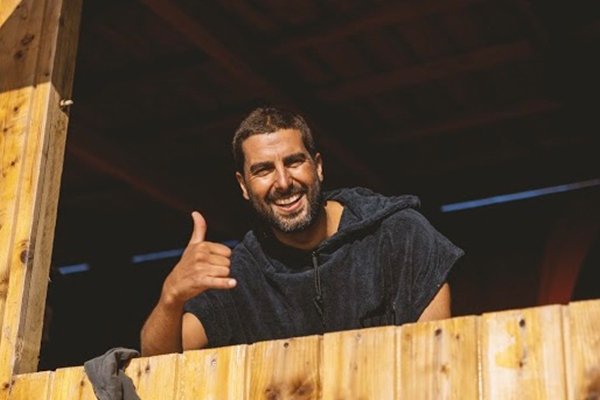
Surf Instructor & Founder of Imagine Surf School
With more than 15 years of experience as a surfer, he created Imagine Surf School, dreaming of making a better world through surfing. For him, it´s more than just riding a wave. It´s a lifestyle. It´s becoming a better human being every day. In his lessons, you will have the opportunity to live and experience a total connection with the sea and with Nature.
Planning a weekend in Comporta? Discover my two-day itinerary for…
Find out what surfing in Portugal is like in winter,…