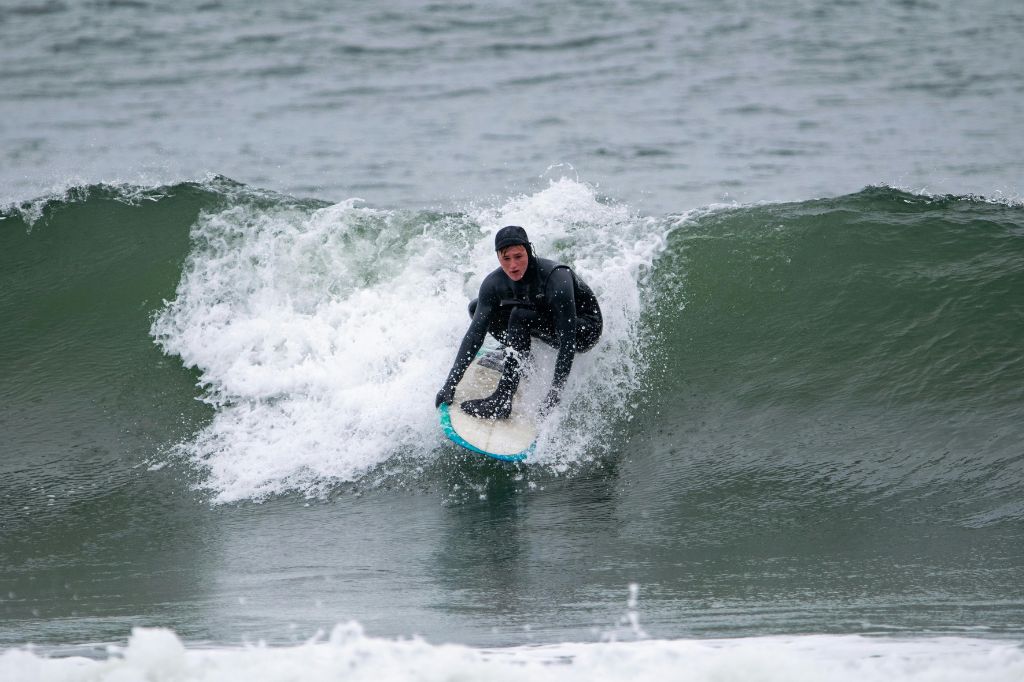
A Weekend in Comporta: Your Perfect Plan! (created…
Planning a weekend in Comporta? Discover my two-day itinerary for…
When people try surfing for the first time, most of them have one goal in mind: stand up.
I understand that. Standing on your first wave is a great feeling.
But after years of teaching beginners, I have learned that the people who progress best are not usually the ones who rush to their feet. They first learn how to handle the board, understand what the ocean is doing and stay relaxed when the wave arrives.
Surfing becomes much easier when you stop treating the take-off as the only goal.
In this beginner surfing guide, I’ll go through the basic techniques I focus on most: choosing the right conditions, paddling, catching a wave, standing up, finding your stance and staying safe in the water.
If you are completely new to surfing, this is the order I would think about things:
First learn | Why it matters |
Ocean and safety basics | You need to understand where and when it is safe to surf |
Board control | A surfboard is much easier to use when you know how to position and handle it |
Paddling | Good timing starts before the wave reaches you |
Catching the wave | Feel the board start to glide before trying to stand |
Take-off | A controlled movement works better than rushing |
Basic stance | Balance, soft knees and looking ahead help you stay on the wave |
Wave awareness | Eventually, you need to understand which waves to choose and where to position yourself |
Beginner tip: Do not measure your first session only by whether you stand up. Learning to control the board, catch waves and feel more comfortable in the ocean is already real progress.
The first thing I teach has nothing to do with standing on a board.
It is learning to recognise the right conditions.
A complete beginner does not need powerful waves. You need manageable conditions, enough space and a beach where you can practise without constantly fighting the ocean.
Before entering the water, look at:
If you cannot understand what you are looking at yet, that is normal. It is also one of the strongest reasons to start with an instructor rather than choosing a beach from a surf forecast and going out alone.
At Imagine Surf School, this is part of every lesson: before going into the water, we look at the conditions, explain the safety rules and practise the basics on the sand.
If you are planning to surf in this area, I explain how the beaches and conditions can change in my guide to surfing in Comporta
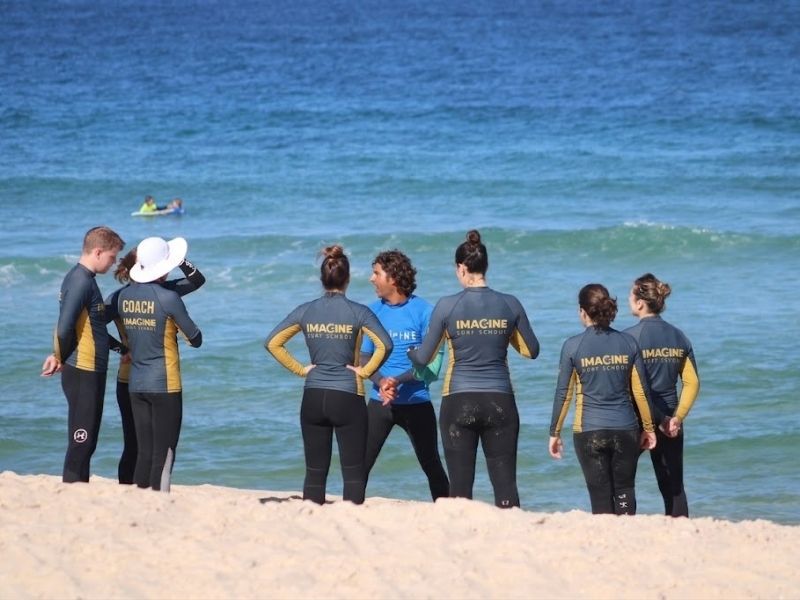
One of the easiest ways to make surfing unnecessarily difficult is to start with the wrong board.
Beginners usually benefit from a board with enough volume and stability for their size and level. A board that is too small may look more exciting, but it makes paddling, catching waves and standing up much harder.
The right beginner board should help you:
This is why I would not choose a board just because of how it looks or because an experienced friend rides something similar.
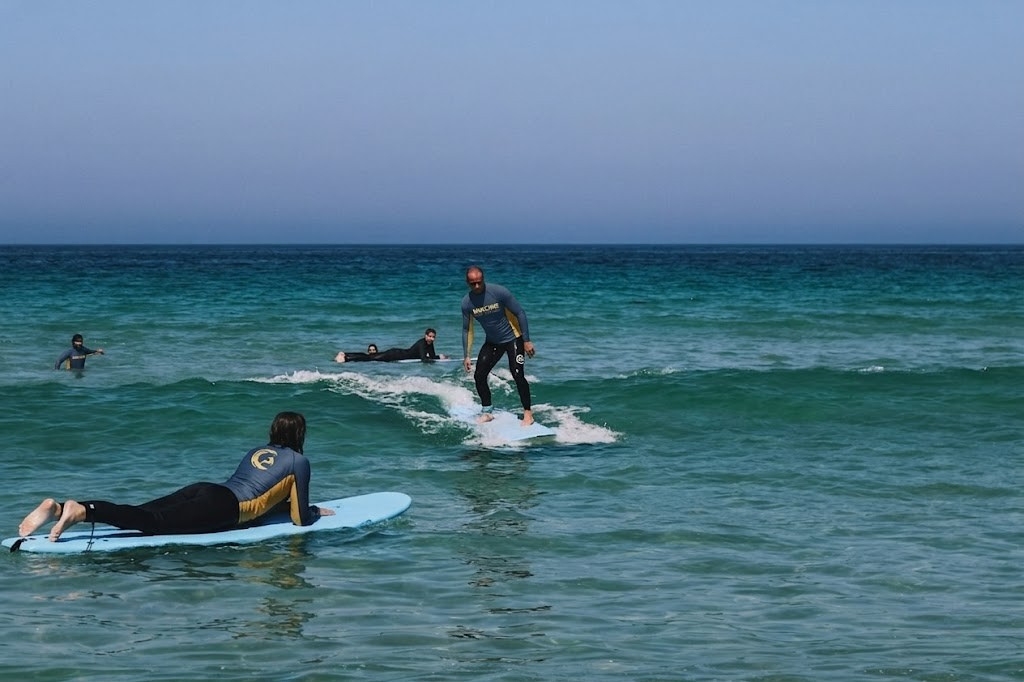
A lot of beginner problems start before the wave even arrives.
If you lie too far forward, the nose of the board may dig into the water. Too far back, and you create unnecessary drag and struggle to build speed.
Try to find a balanced position where the board moves smoothly through the water.
When you paddle:
Good paddling is not about using as much strength as possible. It’s about positioning, timing and efficiency.
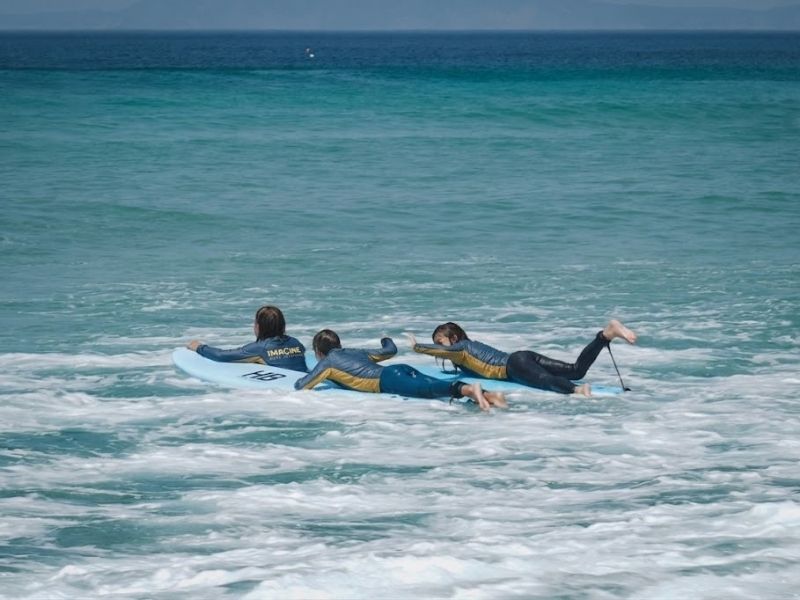
This sounds obvious, but it is one of the most common mistakes I see.
Beginners often start the take-off before the board has actually caught the wave.
First, let the wave do its job.
Point the board in the direction you want to go and start paddling before the wave reaches you. As the wave begins to push the board, keep paddling until you feel that clear moment when the board starts moving on its own.
Once the board is gliding, then think about standing.
✔ Do this: Wave coming → paddle → feel the board accelerate → take off
❌ Avoid this: Wave coming → panic → stand too early 😀
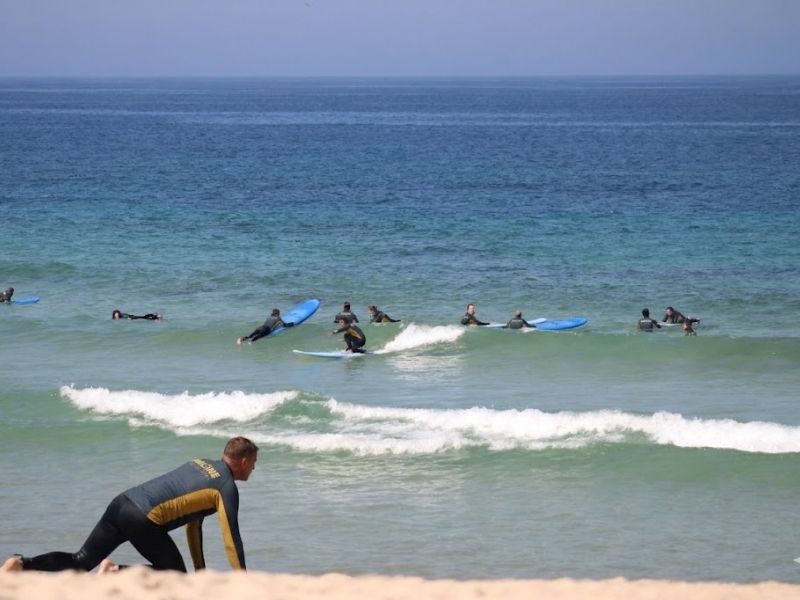
The take-off (sometimes called the pop-up) is what most beginners focus on first.
My advice is to keep it simple.
Place your hands on the board close to your chest and push your upper body up. Use the standing method that suits your mobility and level. If you can, bring your feet underneath your body smoothly without lingering on your knees.
Not everyone needs to stand up in exactly the same way. What matters is finding a controlled movement that gives you a stable position on the board.
A few things help:
And practise it on the sand first.
At Imagine Surf School, the beginning of the lesson includes preparation, warm-up and practice on the beach before we enter the water.
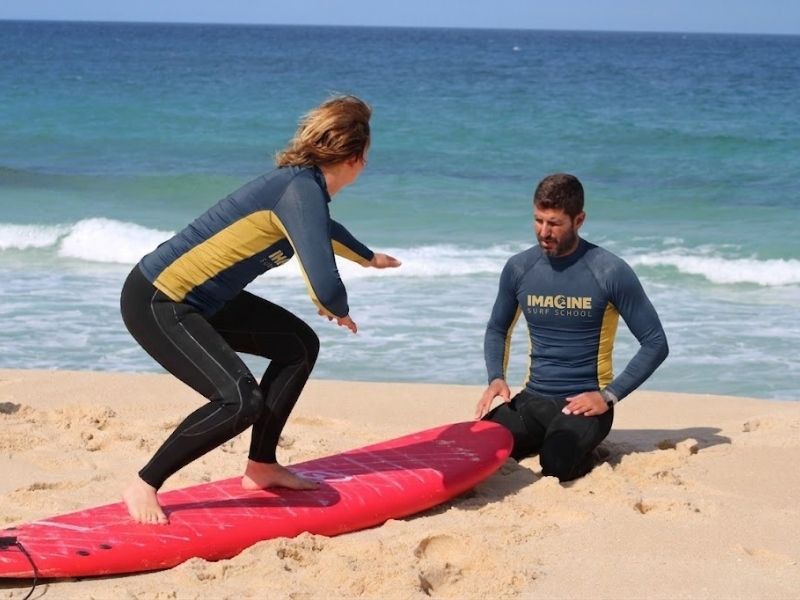
Many beginners look at their feet because they want to check whether they are standing correctly.
The problem is that your body tends to follow your eyes.
If you look straight down, your posture closes and your balance becomes harder to control.
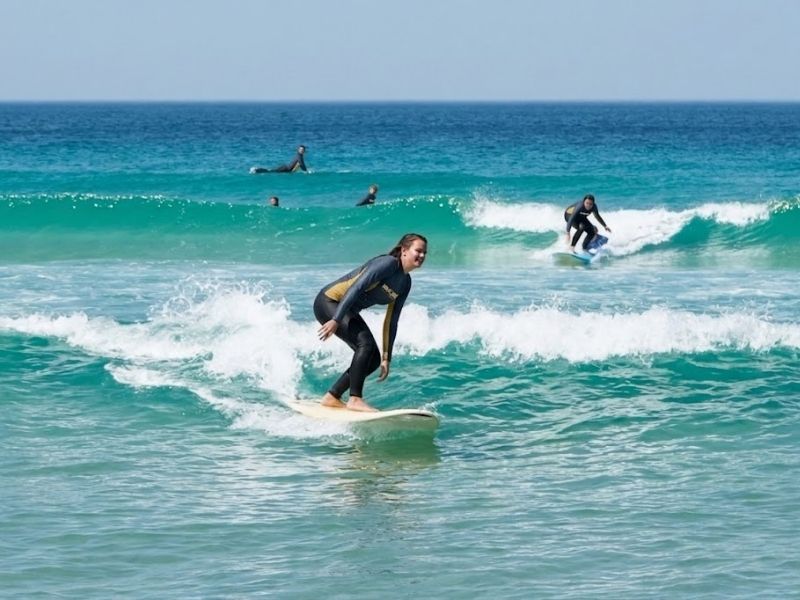
Once you are standing:
Think about being stable but relaxed.
You do not need to look stylish. You just need enough balance to start understanding how the board moves underneath you.
Falling is part of surfing.
A lot of it.
Learning how to fall is just as important as learning how to stand up.
When you lose balance:
Always wear a correctly fitted leash and keep control of your board whenever it is safe to do so. If you get into difficulty, your board can also provide useful flotation, but it should never replace basic swimming ability or good ocean awareness.
Do not fight every fall.
Sometimes the safest move is simply to let yourself fall, reset and try the next wave.
Common mistake | What to do instead |
Choosing waves that are too powerful | Start with smaller, manageable conditions |
Using a board that is too small | Choose stability and volume while learning |
Paddling too late | Start earlier and build speed before the wave reaches you |
Standing before catching the wave | Wait until you feel the board glide |
Looking at your feet | Keep your eyes ahead |
Standing too upright | Bend your knees slightly and stay relaxed |
Trying to progress too fast | Repeat the basics until they become natural |
Surfing somewhere unfamiliar alone | Get local guidance until you can confidently read the conditions |
One thing I see often is that beginners think repeating a basic exercise means they are not progressing.
It is usually the opposite.
Surfing improves through repetition.
Your first few sessions do not all need to look the same.
A simple progression might be:
Some beginners stand up during their first lesson. Others need more time.
Both are normal.
Many beginners catch their first waves in one session, but real progression takes practice and repetition.
Technique is only part of learning to surf.
You also need to understand that you are sharing the ocean.
Start with a few simple habits:
You do not need to understand every surf rule on your first day.
But you do need to understand that good surfing includes awareness of the people and environment around you.
Can you teach yourself some surfing basics?
Of course.
But beginners often struggle with things that are difficult to see from the board: whether they are positioned correctly, why they are missing waves, whether the conditions are suitable or what exactly is going wrong during the take-off.
Good instruction gives you feedback in the moment.
At Imagine Surf School, our beginner surf lessons are mainly based at Pego Beach (Comporta) and are built around safety, board control, take-off technique and catching your first waves. We keep groups small and adapt the lesson to the level, confidence and ocean conditions of the people in front of us. If you prefer more individual attention, our private surf lessons allow the session to be adapted even more closely to your level, pace and goals.
For me, that is where an instructor adds the most value: by helping you understand what to change on the next wave.
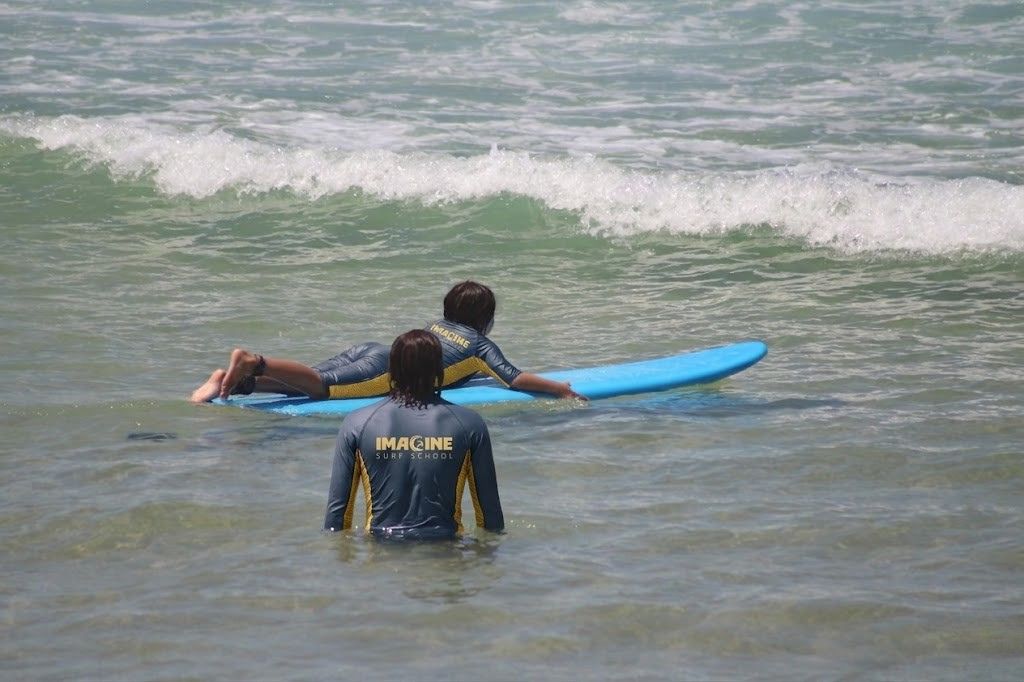
You can learn the basics in one session, and many beginners manage to stand up and catch their first waves. Becoming consistent takes more time and practice.
I would choose a stable board with enough volume for your size and experience. The exact board depends on the surfer, which is why a good surf school or rental should help you choose rather than giving everyone the same equipment.
You do not need to be an exceptional swimmer, but you should be able to swim, float and feel reasonably comfortable in the water. If your swimming ability is limited, tell the surf school before the lesson so they can assess whether the conditions and supervision are appropriate.
It depends on the confidence level of the student. Whitewater allows you to practise board control, catching waves and the take-off without immediately dealing with all the positioning required for unbroken waves.
As you become more confident and the conditions are suitable, you can start progressing towards unbroken waves.
There is no fixed number. One lesson can be enough for a first experience, but several sessions over a few days usually help you build confidence, improve your technique and understand the ocean better.
Surfing is difficult at the beginning.
That is also why the first small improvements feel so good.
Do not worry too much about how quickly someone else stands up. Learn to read the ocean. Get comfortable on the board. Catch waves. Repeat the take-off. Fall. Try again.
The technique comes faster when you are not fighting yourself or the ocean.
And when you eventually stand up and ride that first proper wave, you will understand why so many of us keep coming back.
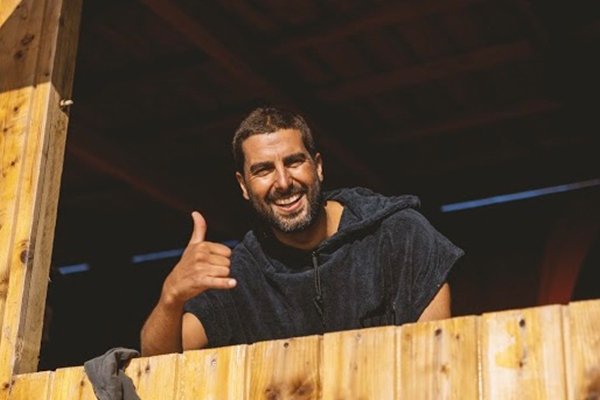
Surf Instructor & Founder of Imagine Surf School
With more than 15 years of experience as a surfer, he created Imagine Surf School, dreaming of making a better world through surfing. For him, it´s more than just riding a wave. It´s a lifestyle. It´s becoming a better human being every day. In his lessons, you will have the opportunity to live and experience a total connection with the sea and with Nature.
Planning a weekend in Comporta? Discover my two-day itinerary for…
Find out what surfing in Portugal is like in winter,…